ZilvaEdge Delivers Research-First Content That Actually Works

The ZilvaEdge System produces publication-ready content using a research-first methodology, an automated quality loop, and human expertise on every piece. Research is completed before writing begins, and nothing is delivered until it passes every gate.
/ The ZilvaEdge SYSTEM
check icon

Every piece is built on structured research covering competitors, keywords, audience intent, and industry terminology.

check icon

An automated feedback loop scores content against the 50 or more criteria we work to, across up to three refinement passes in our framework.

check icon

Seven quality gates verify research, accuracy, brand voice, SEO, readability, compliance, and overall quality.

check icon

Human experts review every output for tone, industry nuance, and strategic fit.

The cost of this approach is real. Content ranks nowhere. Blog posts attract zero leads. Service pages fail to convert. Months of publishing pass with nothing to show for it. For regulated industries like healthcare, financial services, and legal services, the stakes are even higher. Inaccurate or non-compliant content does more than underperform. It creates risk.
The ZilvaEdge System exists because we believe content production should be transparent, research-driven, and held to a measurable standard. It is built on four pillars including a research-first methodology, a feedback loop that refines content automatically, a human expertise layer, and a quality gate process with seven checkpoints.

This page explains each pillar in detail and covers what we do, why we do it, and how it applies to your industry. If you want the short version, our guide to how our research-first content system actually works covers the essentials in blog form. This is the complete version.

This system is built for businesses that need content they can trust. Healthcare and medical practices that need accuracy and compliance awareness. Professional services firms that need authority and credibility. Digital agencies that need a reliable content partner delivering consistent quality at scale. If DIY AI tools have fallen short for you, or in-house production has become hard to sustain, this is the situation the system was designed to address.


Research-First Methodology

Typical content starts with a brief and ends with a draft. Our content starts with research which is structured and documented research that takes days instead of minutes.

This is not a quick Google search or a skim of the first page of results. It is a systematic investigation of your market, your competitors, your audience, and the search environment around your business. The research is completed before writing starts, and it forms the foundation for every piece of content.

What We Research Before Writing

Every client engagement begins with a research phase that covers multiple dimensions.
Competitor Analysis
Competitor Analysis
We identify your direct competitors and review their content in detail. We look at what topics they cover, what they rank for, where they are strong, and where the gaps are. This helps position your content to compete more effectively instead of copying what already exists.
Keyword Mapping
Keyword Mapping
We map the search terms your potential customers actually use. This includes obvious high-volume terms and long-tail queries that reveal intent. For example, “dental implants Brisbane” shows what someone wants, while “how much do dental implants cost and are they worth it” shows where they are in the decision-making process. Both matter.
Audience Intent Analysis
We analyse why people search, what problem they are trying to solve, what stage they are in, and what kind of content will help them. Someone searching "what is a website audit" needs different content from someone searching "website audit pricing Australia".
Industry Terminology
Every industry has its own language. Healthcare professionals, accountants, and digital marketers all communicate differently. We study the terms your industry uses, how your customers describe their problems, and what tone builds trust in your market. This helps the content sound informed, natural, and relevant to your field.
AI Visibility Assessment

Search is changing. We see more buyers putting their questions to AI platforms like ChatGPT, Google Gemini, and Perplexity, and those platforms surface and recommend businesses in their answers. We assess how visible your business is in AI-generated responses and identify opportunities to improve your presence in this growing channel. The good news is that there is no separate playbook here. Google confirms there are no additional requirements to appear in its AI features beyond the same people-first practices that win in search Google Search Central, 2026. For a deeper look at what this means in practice, see our explainer on what AI readiness is and why your website needs it.


Search Landscape Mapping
We review the wider search market around your business to see what content exists, who dominates, where opportunities sit, and how AI search has changed visibility. This gives us a strategic view that guides both individual content pieces and the broader content plan.

How Research Compounds Over Time

The research we conduct is not disposable. It is maintained, updated, and expanded over time.

When we write your first blog post, we are working from competitor analysis, keyword research, and audience insights. By the tenth, that foundation is stronger. New keyword opportunities, updated competitor data, and fresh audience insights all feed into better content.

This is one of the biggest advantages of a research-first approach. Each piece of content benefits from what came before it and adds knowledge that improves what comes next.

Why Competitors Skip Research and Why It Costs Them

Research takes time. It requires expertise. It is the unglamorous part of content production that nobody sees in the final deliverable. That is why most providers skip it or reduce it to a token effort.
The result is content that is generic, poorly targeted, and easily outperformed. It might read well in isolation, but it does not account for what competitors have already published, what the audience actually needs, or where the genuine opportunities lie. In our experience, the pieces we build on a documented research foundation hold their position and earn engagement that thin, unresearched content rarely matches.

The Feedback Loop

Writing is only the beginning. What happens after the first draft separates publication-ready content from "hope it is good enough" content.

The ZilvaEdge Feedback Loop is an automated refinement process that scores every piece of content against defined quality criteria and refines it until it meets the standard. This is not a subjective review where someone reads the piece and decides it "feels right". In our framework it is a structured assessment against more than 50 specific criteria.

How the Feedback Loop Works

Every piece of content goes through the same process.
1
Assessment
The content is scored against defined quality standards, including accuracy, readability, SEO optimisation, brand voice alignment, structure, and completeness.
2
Identification
Any gaps are clearly identified. This means specific feedback, not vague notes like "needs improvement". A section may need stronger evidence, a heading may not match search intent, or a paragraph may use language that does not fit the audience.
3
Refinement
The content is improved based on the identified gaps. This is not a full rewrite. It is a targeted refinement that fixes what needs work while keeping what already meets the standard.
4
Re-assessment
The refined content is scored again. If it now meets all criteria, it moves forward. If gaps remain, the cycle continues.

Why This Matters for Your Business

Many content providers follow a single-pass model. They write, do a quick review, and deliver. The content may be checked for spelling and basic flow, but not systematically assessed for accuracy, quality, or effectiveness.

The Feedback Loop closes that gap. Every piece goes through a documented quality process before delivery, so you receive content that has been checked against a clear standard.

For regulated industries, this matters even more. A healthcare blog with an unsupported claim can create compliance risk. A financial services page with misleading language can create regulatory issues. The Feedback Loop is designed to catch these problems before delivery, not after publication.

For more detail on what separates good content from average content, see our no-nonsense guide to what makes good content.

If this is the kind of process you want behind your content, you can explore our service packages or get in touch to talk through your needs.


Human Expertise Layer

AI is powerful. It can process information quickly, generate text efficiently, and support content production at scale. But AI alone is not enough.

AI does not understand your industry the way a person does after proper research. It does not fully understand the nuances of AHPRA advertising guidelines, the concerns of a patient choosing a surgeon, or the way competitors have changed their messaging. These details require human judgement, research, and oversight.

What the Human Layer Actually Does

Research and Industry Knowledge
We study your industry before creating content. For healthcare practices and professional services firms, this means looking at how people search, what language they use, what concerns they have, and what regulatory requirements apply. This helps the content sound informed and relevant to your market.
Quality Review on Every Piece
Every piece of content produced through the ZilvaEdge System is reviewed by a real person who understands your industry, brand voice, and content standard. This review catches issues automated systems may miss, including tone problems, industry-specific inaccuracies, and claims that may technically pass a check but still feel wrong in context.
Strategic Oversight
They decide which topics to prioritise, how to position content against competitors, and how each piece connects to the broader strategy. AI can support execution, but strategy still requires context, experience, and judgement.

For more on how this approach connects to a broader plan, see our explanation of why every business website needs a content strategy.

Why AI Alone Is Not Enough

The market is full of AI content tools that promise to replace writers entirely but readable text is not the same as effective or trustworthy content. Google's own guidance is clear on this point. It rewards content created primarily for people that demonstrates genuine first-hand expertise, not content engineered to game rankings Google Search Central, 2026.

AI-generated content without human oversight has three consistent weaknesses.
  • Accuracy gaps
    AI can produce plausible-sounding text without verifying claims against current sources. This is especially risky in regulated industries.
  • Generic positioning
    AI often defaults to broad industry language because it does not fully understand your competitive environment or your audience’s specific needs.
  • No strategic coherence
    AI can create individual pieces of content, but it does not build a connected content strategy on its own.
The Human Expertise Layer addresses these gaps. Humans bring research, verification, and strategic thinking. AI brings speed, consistency, and scale. Together, they support content that is both efficient and carefully reviewed.

Quality Gates

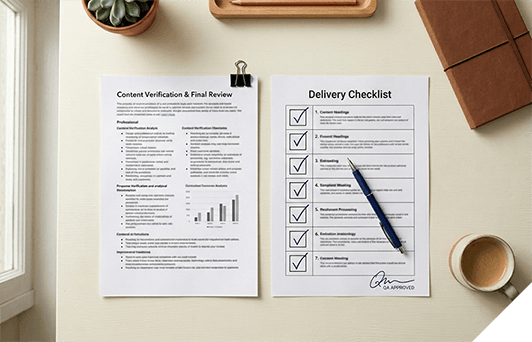
The Quality Gate Process is where everything comes together. Seven checkpoints are applied to every piece of content, to ensure nothing reaches you that has not been thoroughly verified.

Many providers have a quality process of some kind. Usually, it involves one person reading the content and deciding it seems acceptable. Our process is more rigorous, more systematic, and more transparent.

The Seven Quality Gates

Gate 1
Research Verification
Is the content backed by documented research? It should reflect the competitor analysis, keyword data, and audience insights from the research phase. If it is not grounded in research, it fails the first gate, no matter how well it reads.
Gate 2
Accuracy Check
Are all claims verifiable? Are statistics current? Are regulatory references correct? This gate catches errors that damage trust, including outdated data, unsupported claims, and misrepresented industry information.
Gate 3
Brand Voice Alignment
Does the content sound like your business? Each client has a defined voice, whether formal, conversational, technical, accessible, authoritative, or approachable. This gate checks that the content matches the agreed voice, not a generic corporate tone.
Gate 4
SEO Optimisation
Is the content structured to perform in search? This includes heading structure, natural keyword use, click-focused metadata, and internal linking that supports topical authority.
Gate 5
Readability
Can the target audience understand the content? Technical accuracy matters, but content that is too dense, too complex, or too full of jargon will not do its job. This gate checks readability against the audience profile.
Gate 6
Compliance Awareness
For regulated industries, this gate checks common compliance considerations, such as AHPRA for healthcare, ASIC for financial services, and TPB for tax practitioners. This does not replace legal review, but it helps catch obvious issues such as unsupported claims, misleading projections, or testimonial use that may not meet guidelines.
Gate 7
Final Review
An extensive final check covering structure, flow, formatting, and overall quality. This is the last checkpoint before the content is delivered, and it catches anything the previous six gates may have missed.

What Happens When Content Fails a Gate

Content that fails any gate does not move forward. It is returned for specific and targeted revision with clear documentation of what needs to change and why. This is not a vague "needs work" but a precise identification of the issue and the standard that must be met.

The content then enters the Feedback Loop for refinement and returns to the gate it failed. Only when it passes all seven gates is it marked as publication-ready and delivered.

Why Seven Gates Rather Than One

A single review can catch surface-level problems like spelling errors, awkward phrasing, or obvious factual mistakes. It can also miss deeper issues, such as weak research, missing SEO elements, brand voice drift, or overlooked compliance concerns.

Seven gates give the content seven focused quality checks. Each gate reviews a specific area with defined pass or fail criteria. The result is content assessed from every angle that matters, not just the issues one reviewer happens to notice.

How It Works for Your Industry

The ZilvaEdge System applies the same methodology across every industry we serve. The four pillars do not change. What changes is how they are applied through the research we conduct, the terminology we use, the compliance considerations we assess, and the audience we write for.

Digital Agencies

Digital agencies understand content marketing, but producing content for their own brand or scaling content for clients often falls down the priority list. Agencies need a partner that understands the industry, delivers consistent quality, and does not require hand-holding.


How the system adapts for agencies:

White-label content is delivered ready for your branding. Your clients see your agency’s name on research-backed, quality-assured content, without your team having to produce it in-house. Research is included, so your team does not need to brief us on every keyword or provide competitor analysis. We do that work as part of the standard process.

Consistency at scale is where the system delivers its strongest value. Whether you need 5 blog posts a month or 50, every piece goes through the same research, feedback, and quality gate process.

Content covers the technical depth digital marketing audiences expect, including SEO, advertising strategy, conversion optimisation, and analytics. It is written by people who research these topics properly and understand how they connect.

The Full Workflow

Understanding the system's pillars is useful, but you probably want to know what the actual experience looks like. Here is the step-by-step workflow from engagement to delivery, including what you need to do at each stage. The short answer is not much.
1
Brief and Onboard

You tell us about your business, your audience, your brand voice, and your content needs. This can be as simple as completing our onboarding form, which captures the essential information we need to begin research. If you have existing brand guidelines, competitor lists, or content examples you like, those are helpful but not required.

What you do: Complete the onboarding form at What We Need From You. Provide any existing brand materials if available.

2
Research

We conduct the full research phase covering competitor analysis, keyword mapping, audience intent analysis, industry terminology review, AI visibility assessment, and search landscape mapping. This research is documented and maintained for all future content production.

What you do: Nothing. This is our work.

3
Write

Content is produced using the research foundation, following your brand voice guidelines, and targeting the specific keywords and audience segments identified in the research phase. AI handles the heavy lifting of content generation, guided by the strategic direction and research that humans have established.

What you do: Nothing. This is our work.

4
Audit and Refine

The Feedback Loop assesses the content against the 50 or more quality criteria we score it against, identifies gaps, and refines the content through up to three iterations until it meets the publication-ready standard the way we define it.

What you do: Nothing. This is our work.

5
Quality Gates

All seven quality gates are applied, including research verification, accuracy check, brand voice alignment, SEO optimisation, readability, compliance awareness, and final review. Any failures are addressed before the content moves forward.

What you do: Nothing. This is our work.

6
Deliver

Publication-ready content is delivered to you. Every piece has passed all quality gates. Express 7-day turnaround is available as a premium option for time-sensitive projects.

What you do: Review and publish. The content is ready.

What This Means in Practice

For most clients, the experience is remarkably simple. You brief us once, provide basic information about your business, and receive publication-ready content. The research, writing, refinement, and quality assurance all happen without requiring your ongoing involvement. You review the final product, not multiple drafts, not rough outlines, not content that needs significant rework.

Your time investment is measured in minutes, not hours. Our time investment is measured in the research, expertise, and quality processes that make the content worth publishing.


What This Means for You

The ZilvaEdge System is not a technology demo. It is a production methodology designed to solve the specific problems that businesses face with content, including inconsistent quality, no research foundation, unclear processes, and the impossible choice between expensive agencies and unreliable AI tools.

What You Get

Publication-ready content, every time
Not rough drafts. Not "pretty good" content that needs your team to rework it. Content that has been researched, written, refined, and verified through seven quality gates before it reaches you.
Research included, not extra
The research phase is built into the system. Competitor analysis, keyword mapping, and audience research are all included as standard. You are not paying extra for the foundation that makes content effective.
A transparent process
You know what happens to your content at every stage. There are no black boxes, no mystery processes, and no wondering whether anyone actually checked the facts or studied your industry.
Human expertise on every piece
Content and marketing specialists who research your industry, review every output, and ensure accuracy, tone, and quality. Not AI-only. Not automated and untouched. Human judgement where it matters most.
A system that scales
Whether you need one blog post or thirty, the same research foundation, the same feedback loop, the same quality gates, and the same human oversight apply to every piece. Quality does not degrade as volume increases.

Getting Started

If you are ready to experience the difference that research-first, quality-assured content makes, here is where to begin.
Tell us about your business

Complete our onboarding form at What We Need From You to get the process started.

See the pricing

Every service has a transparent price. No hidden fees, no surprise invoices. View pricing.

Explore our services

Website audits start from $100. Blog posts start from $150. Strategy starts from $500. See the full range at our packages page.

Have questions?

Visit What We Need From You to see exactly what information we require to begin, or get in touch for full details.

The content your business publishes is a direct reflection of your brand. It either builds trust or erodes it. It either attracts the right clients or repels them. It either performs or it does not. The ZilvaEdge System is built to give your content a sound foundation to perform.
/ FAQ

Frequently Asked Questions

The ZilvaEdge System is a content production methodology that combines research-first planning, automated quality refinement, human expertise, and seven quality gates to produce publication-ready content. Every piece is built on documented competitor analysis, keyword research, and audience insights, then refined through a structured feedback loop and reviewed by content and marketing specialists before delivery.

The system is designed for businesses that need content they can trust, particularly healthcare and medical practices requiring accuracy and compliance awareness, professional services firms that need authority and credibility, and digital agencies that need a reliable content partner delivering consistent quality at scale. If DIY AI tools have disappointed you or agency costs have become unsustainable, this system was built for your situation.

Standard blog posts start from $150, and long-form content and service pages start from $250. Website audits start from $100 and website strategy starts from $500, with the Transformation tier at $1,250. All prices include the research foundation, feedback loop, human review, and quality gate process. There are no hidden fees or lock-in contracts. See our pricing page for the full range.

Standard turnaround delivers publication-ready content within the timeframe outlined at purchase. Express 7-day turnaround is available as a premium option for time-sensitive projects. You receive finished content, not rough drafts that need reworking.

Browse our services and purchase directly on the website. Then complete the onboarding form at What We Need From You with basic information about your business. We handle the research, writing, refinement, and quality assurance from there. No calls or consultations are required.
No. The research phase is built into the system. We conduct competitor analysis, keyword mapping, audience intent analysis, and industry-specific research before writing begins. You provide basic information about your business and any existing brand materials if available. We do the rest.

Content for regulated industries is produced with compliance awareness built into the research phase. For healthcare, we study AHPRA advertising guidelines and write with those requirements in mind. For financial services, we account for ASIC regulatory guidance. This is not a replacement for legal review, but it means the starting point is informed rather than ignorant, which significantly reduces compliance corrections.
/ GET STARTED

Helpful ZilvaEdge Links

© 2026 ZilvaEdge. All rights reserved.